Claude Haiku 5.5 came out on October 7, 2026. It is the first Haiku with an effort setting. Leave that control alone and you get medium. On the Artificial Analysis Intelligence Index, medium is 34. The version in the launch materials is max, and max is 43.
That 43 is 26 points above Haiku 4.5, which sits at 17, and 13 points behind Sonnet 5.5 at max, which is 56. The launch table does not name the effort on the Haiku cells. A Briefcase score or a computer-use score from that table is a published result. It is the top of the ladder. Out of the box, you are two rungs down.
On the API the id is claude-haiku-5-5. Context is 1 million tokens, up from 200,000. Max output is 128,000, up from 64,000. Input is text and image. Output is text. The reliable knowledge cutoff is June 2026. Adaptive thinking is on. The same text counts as about 30% more tokens than it did on Haiku 4.5, so a max_tokens sized for the old model can stop after the thinking and before the answer.
The launch version is the top of the ladder
Artificial Analysis ran the five efforts. High, at 38, is GPT-6 Luna's max. Max, at 43, sits just ahead of GLM-5.3 Flash at 42 and Gemini 3.8 Flash at 41, and just behind Kimi K3 at 44.
| Effort | Intelligence Index |
|---|---|
| Low | 29 |
| Medium | 34 |
| High | 38 |
| Xhigh | 41 |
| Max | 43 |
The tokens decide whether the launch version is worth turning on. At max, one index task uses about 162,000 output tokens, about three times Luna's max, and more than Opus 5.5 at max. Most of that is reasoning. The step from xhigh at 41 to max at 43 is 2 points for about 1.8 times the tokens. High reaches Luna's 38 with about 55,000 output tokens, against about 50,000 for Luna. The full index run at max produced 440 million output tokens, against a median of 100 million. Low's run produced 32 million.
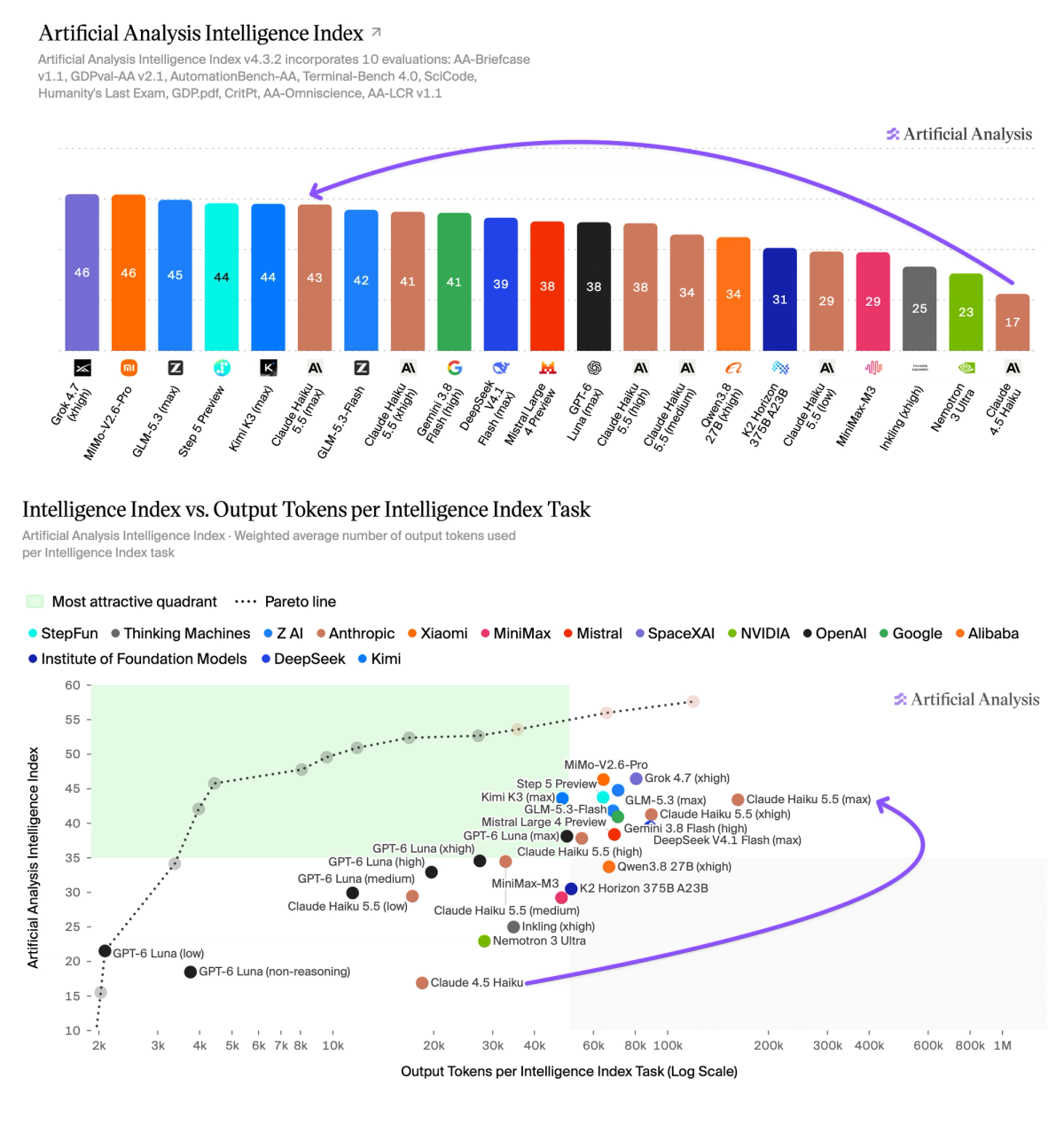
Artificial Analysis. Max is 43, 26 points above Haiku 4.5. On the token chart, max sits far to the right of Luna.
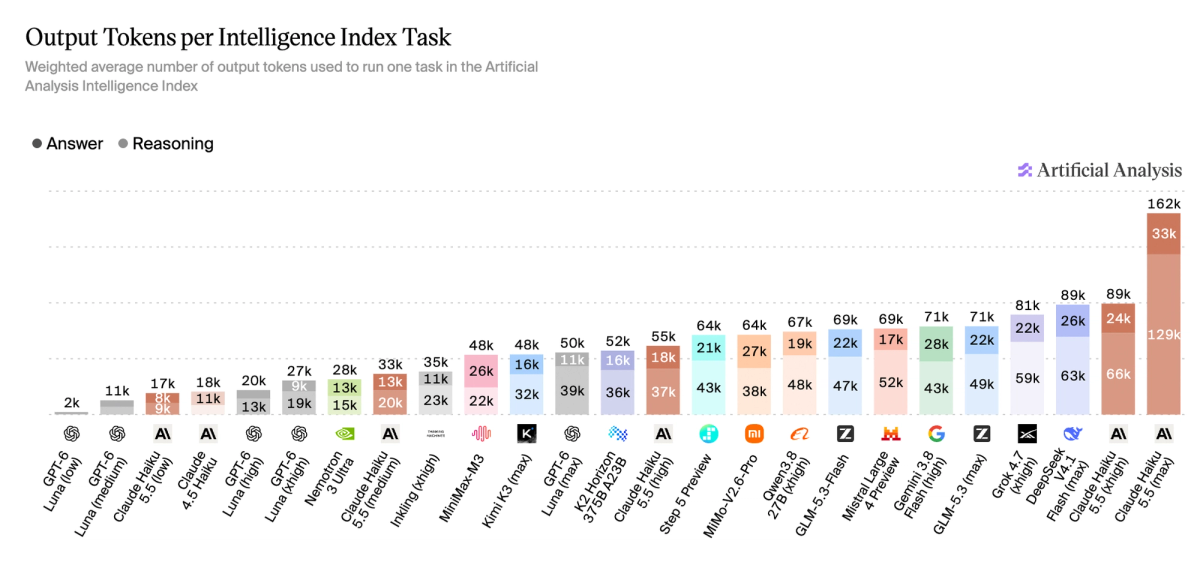
Artificial Analysis. Max is about 162,000 output tokens per task. Most of that bar is reasoning.
Where the launch version earns the extra tokens
On AA-Briefcase, Anthropic and Artificial Analysis both publish 1578 Elo. Haiku 4.5 is 614. Luna is 1336. Sonnet, on Anthropic's table, is 1824. Artificial Analysis puts 1578 inside the confidence interval of Astra at max and of Fable 5.1 at high, and next to Muse Spark 1.3 at max. That 1578 is the launch version. Medium is a lower rung on the same chart.
On AA-Omniscience the model knows less and invents less. Accuracy is 36%, against 55% for Gemini 3.8 Flash and 44% for Luna. The hallucination rate is 40%, against 55% and 77%. Part of the miss is the model saying it does not know.
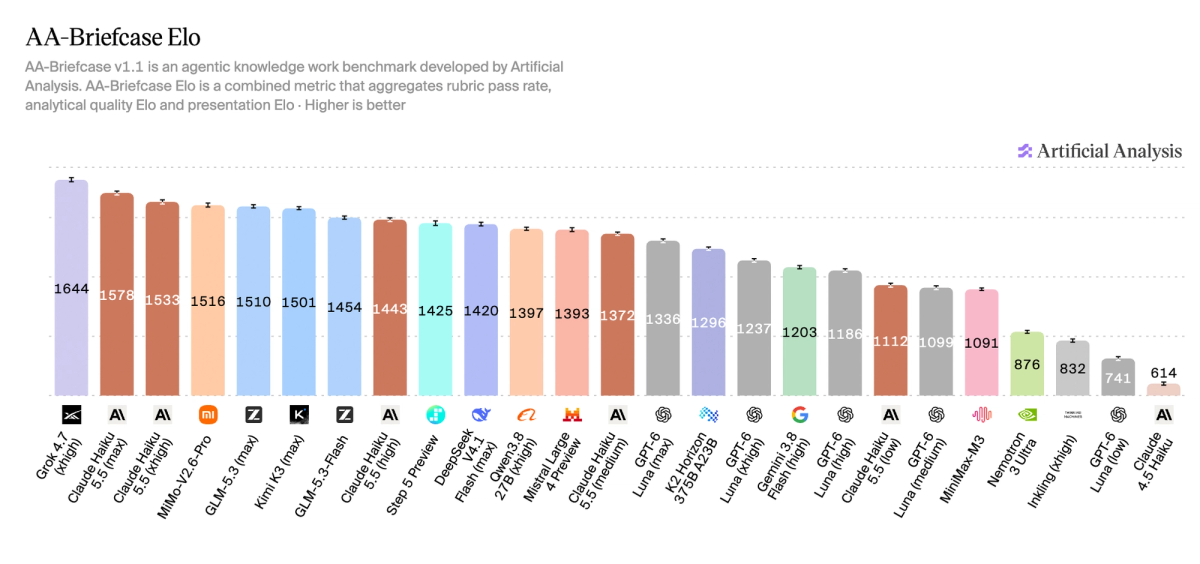
Artificial Analysis. Haiku 5.5 at max is 1578 Elo. Haiku 4.5 is 614. Luna's max on this chart is 1336.
Anthropic's launch table is a second source, and it still does not name Haiku's effort. Keep it separate from the ladder above.
On Terminal-Bench 4.0, Anthropic reports 39.2% for Haiku 5.5, 0.0% for Haiku 4.5, 16.4% for Luna, and 70.6% for Sonnet. Artificial Analysis, on its own run, reports about 33%, level with GLM-5.3 Flash, ahead of Gemini 3.8 Flash at 20% and Luna at 13%, and again 0% for Haiku 4.5. Those are two harnesses. The 0% is a floor. Sonnet's lead is the split that decides where hard terminal work goes.
On FrontierCode 1.1 Main, Anthropic reports 46.4% for Haiku, 42.4% for Luna, and 52.1% for Sonnet at xhigh. Only the Sonnet cell is labeled. On OSWorld 2.1, offline subset, Haiku is 72.4%, Haiku 4.5 is 15.7%, Luna is 48.9%, and Sonnet is 83.9%. On Humanity's Last Exam, Haiku is 45.9% with no tools and 57.4% with tools. Sonnet is 56.9% and 64.5%. On Chartography with no tools, Haiku is 46.4%, Haiku 4.5 is 6.4%, Luna is 29.1%, and Sonnet is 61.6%. On GDPval-AA v2.1, Haiku is 1620, Haiku 4.5 is 735, Luna is 1437, and Sonnet is 1840.
AutomationBench-AA needs a hold. Artificial Analysis measures 35%, against 53% to 60% for Luna, Gemini 3.8 Flash, and GLM-5.3 Flash, and says a pre-release safety refusal made the model over-refuse. They expect a higher score on the re-run.
The price, once you have chosen a version
Under 100,000 input tokens, Haiku 5.5 is $0.10 per million input tokens and $0.50 output. Cache reads are $0.01. Five-minute cache writes are $0.125. That list price matches Luna, and it is 90% below Haiku 4.5 at $1 and $5. Above 100,000 input tokens the whole request is five times that: $0.50, $2.50, cache reads at $0.05, cache writes at $0.625. Anthropic says about 90% of requests to the previous Haiku were under the line, and that a typical mix now costs about 75% less to run, tokenizer included.
Artificial Analysis has priced the index tasks at the lower rate only. Low is $0.02 a task and max is $0.21, with up to an 8.7-fold spread across the five efforts. Those figures do not include the step up.
The same launch cuts Sonnet 5.5 cache reads from $0.20 to $0.10. Anthropic's estimate is about 20% less on most agentic work. Sonnet's input and output stay $2 and $10. The model that still leads Terminal-Bench got cheaper to reuse on the day the small model arrived.
In practice
- Out of the box you get medium, and medium is 34. The 43, the 1578 on Briefcase, and the computer-use line in the launch table are the version you turn on.
- For work that has to match Luna, use high. That is 38, at about 55,000 output tokens per index task. Max adds 2 points over xhigh and about 1.8 times the tokens, and one task runs to about 162,000 output tokens.
- Keep Sonnet 5.5 on hard terminal work. Anthropic's split is 70.6% against 39.2%. Sonnet's cache read is now $0.10. Haiku 4.5's 0% on this bench is a floor, on both Anthropic's table and the Artificial Analysis run.
- Use Haiku where the task is narrow and repeated: classification, extraction, compaction, routing, and a subagent under a larger model. That is the workload the effort ladder is built for.
- If a prompt crosses 100,000 input tokens, the whole request moves to $0.50 and $2.50. The $0.02 and $0.21 task prices are the lower rate.
- Leave room in max_tokens. The same text is about 30% more tokens than on Haiku 4.5, and thinking counts toward the limit. Thinking can be turned off at low, medium, and high. At xhigh and max that request returns a 400. Changing effort between turns invalidates the prompt cache.
- Hold AutomationBench at 35% until the re-run. The published score includes over-refusals.
Sources: Introducing Claude Haiku 5.5, Artificial Analysis, the effort comparison, and the model overview. The index ladder, the 162,000-token task, Briefcase at 1578, and the Omniscience rates are Artificial Analysis. The launch table is Anthropic's, and it does not name Haiku's effort. The medium default and the 30% tokenizer change are from the Claude docs.